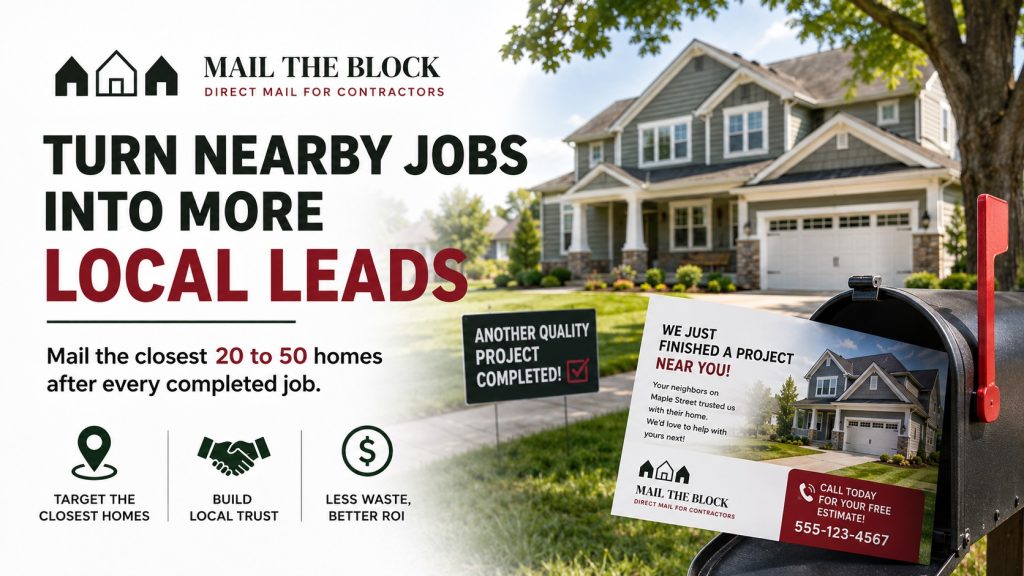
For local contractors, direct mail still works when the message reaches the right homeowner at the right moment. That is where the debate between USPS EDDM and radius marketing gets important.
Every Door Direct Mail, often called EDDM, is popular because it sounds simple. Choose a postal route, print postcards, and reach every home on that route. For broad awareness, that can make sense.
But contractors do not always need broad awareness. A roofer finishing a roof in Farmington, a landscaper wrapping up a patio in Southington, a painter completing a home exterior in Bristol, or a fence company working in West Hartford may not need to mail an entire route. The better move may be to mail the 20 to 50 closest homes around that job.
That is the difference between traditional EDDM and radius marketing. USPS EDDM blankets a route. Mail The Block focuses on the neighborhood closest to the work.
For contractors who want more jobs on the same street, radius marketing is often the sharper, leaner, and more relevant strategy.
What Is USPS EDDM?
USPS EDDM stands for United States Postal Service Every Door Direct Mail. It allows local businesses to send postcards to every address on selected postal carrier routes without needing a traditional mailing list.
For contractors, EDDM printing is commonly used for:
- Seasonal promotions
- Brand awareness campaigns
- Town-wide visibility
- New service area launches
- Repeated mailings into selected neighborhoods
A contractor can use EDDM to reach hundreds of homes at once. That is helpful when the goal is coverage. A lawn care company may want to promote spring cleanups across a large part of town. A roofing company may want to stay visible after storm season. A paving company may want to announce driveway specials before summer.
The challenge is that EDDM is route-based, not jobsite-based.
What Is Radius Marketing?
Radius marketing targets homes within a specific distance or area around a real location. For contractors, that location is usually a completed job, active job, estimate, or high-value project.
Instead of saying, “Send this postcard to everyone on this postal route,” radius marketing says, “Send this postcard to the closest homes around this job.”
That small shift matters.
With Mail The Block, contractors can send a jobsite address and mail postcards to nearby neighbors. The message can reference the street or neighborhood, which makes the postcard feel local instead of generic.
That is why radius marketing is powerful for home services. Neighbors already saw the truck, the crew, the materials, the finished roof, the new fence, the fresh mulch, the driveway, or the painted exterior. The postcard connects that visible proof with a direct call to action.
USPS EDDM vs. Radius Marketing: Side-by-Side Comparison
| Category | USPS EDDM | Radius Marketing with Mail The Block |
|---|---|---|
| Targeting method | Postal carrier routes | Homes closest to a jobsite |
| Typical reach | Hundreds of addresses per route | Smaller batches around active work |
| Best use | Broad neighborhood or town coverage | Hyper-local jobsite follow-up |
| Message style | General service promotion | “We just worked near you” messaging |
| Waste level | Higher if route includes poor-fit homes | Lower because mail stays near the job |
| Trust factor | Based on brand recognition | Based on immediate neighborhood proof |
| Setup | Route selection, EDDM printing, bundling, mailing | Submit job address and postcard details |
| Best for | Awareness campaigns | Turning one job into more nearby jobs |
Both strategies have value. The better choice depends on the goal.
When the goal is to cover a larger area, USPS EDDM can work. When the goal is to win more work near jobs already completed, radius marketing usually gives contractors a more focused path.
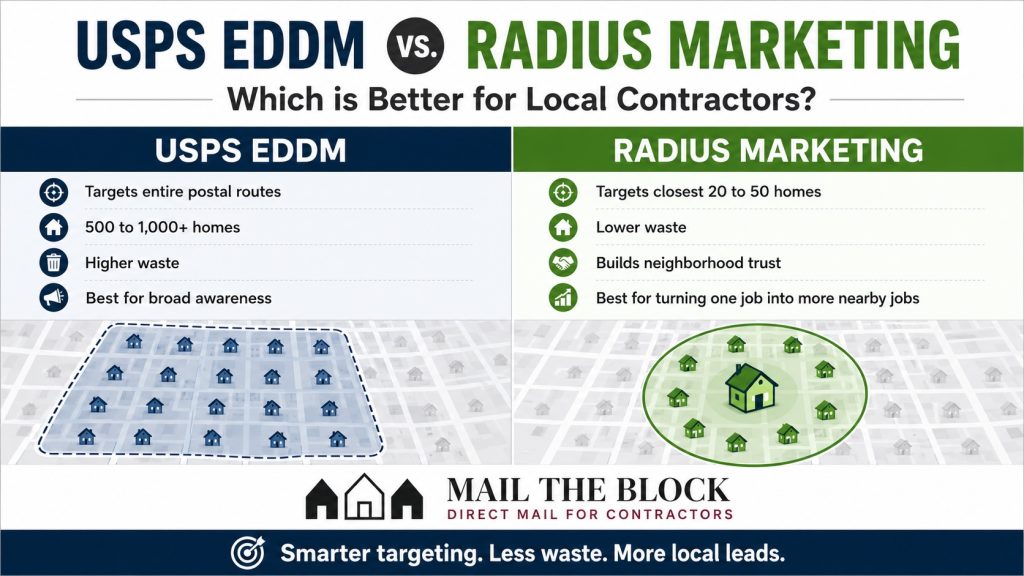
The Main Problem with Every Door Direct Mail for Contractors
Every door direct mail sounds efficient because it reaches a lot of homes. But for contractors, more homes does not always mean better leads.
A postal route can cross different neighborhood types, income levels, property styles, home ages, and buyer intent levels. One route may include ideal single-family homes, rentals, apartments, commercial addresses, or homes far from the job that created the opportunity.
That means a contractor may pay to reach people who:
- Did not see the project
- Do not know the neighborhood connection
- Are outside the ideal service pocket
- Rent instead of own
- Have properties that do not match the service
- Are unlikely to need the offer right now
This is the waste problem.
USPS EDDM is useful when broad exposure is the goal. But a contractor who just completed a roof, patio, fence, driveway, exterior paint job, landscaping installation, or tree removal has a much stronger opportunity nearby.
The closest neighbors are already aware something happened. Some may have watched the work. Some may have noticed the finished result. Some may have already been thinking about the same project.
That is the moment to mail the block.
Why Radius Marketing Works Better After a Completed Job
Home service decisions are local. Homeowners look at what neighbors do. A new roof on the street can make nearby roofs look older. A fresh driveway can make cracked asphalt stand out. New siding can make a faded exterior feel dated. A well-designed landscape can make the next homeowner want a quote.
Radius marketing uses that social proof.
Instead of sending a generic postcard to a large route, the contractor can send a message that feels specific:
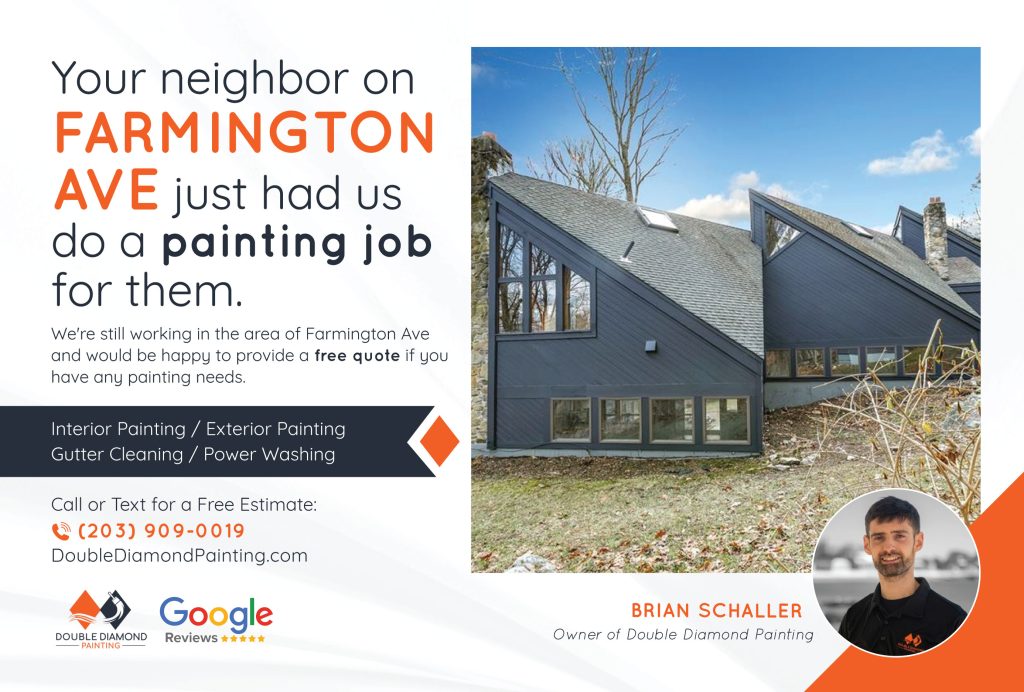
“Your neighbor on Maple Street just trusted us with their project.”
That type of message lands differently because it feels nearby, relevant, and timely.
Mail The Block is built around that exact behavior. Contractors can view postcard examples to see how jobsite-based messaging turns real work into local trust.
Cost Efficiency: Why Smaller Can Be Smarter
A common mistake in contractor marketing is judging campaigns by cost per piece only. EDDM printing may look affordable because the per-piece cost can be low at volume. But cost per piece does not tell the whole story.
Contractors should also ask:
- How many mailed homes are actually near the job?
- How many recipients are likely homeowners?
- How many saw the project happen?
- How many can connect the postcard to real local proof?
- How many addresses are being mailed only because the postal route includes them?
A smaller campaign can perform better when the audience is tighter.
For example, sending to 30 nearby homeowners after a visible project can be more valuable than sending to hundreds of homes across a route where most recipients have no connection to the job. The campaign may be smaller, but the relevance is stronger.
That is why our pricing is structured around address submissions and nearby neighbors. It supports repeated, job-based direct mail without forcing every contractor into oversized routes every time.
When USPS EDDM Makes Sense
USPS EDDM is not a bad strategy. It is just not the right strategy for every situation.
EDDM can make sense when a contractor wants to:
- Launch into a new town
- Build brand awareness across a larger area
- Promote seasonal services
- Reach a full postal route repeatedly
- Support a broader local campaign
- Stay visible in a high-value market
For example, a landscaping company may use EDDM in early spring to promote cleanups across Bristol or Southington. A roofing company may use EDDM before storm season. A paving contractor may use it to build visibility before driveway season.
The key is strategy. EDDM works best when routes are selected carefully, mailed repeatedly, and matched to the contractor’s ideal customer.
When Radius Marketing Is the Better Choice
Radius marketing is usually the stronger choice when a contractor has current or recent work in a neighborhood.
It is especially useful after:
- Roofing installations
- Siding replacements
- Exterior painting projects
- Fence installations
- Landscape design projects
- Patio and hardscape installs
- Driveway paving projects
- Tree removal jobs
- Gutter replacements
- Window and door projects
- Pool, deck, and outdoor living projects
These jobs are visible. That visibility creates trust.
A homeowner may not remember a random contractor postcard. But they may remember the crew that worked three houses down. They may remember the finished project they passed while walking the dog. They may remember the truck parked on the street.
Radius marketing turns that recognition into a lead opportunity.
The GEO Advantage: Why Neighborhood Relevance Matters
Search engines, AI answer engines, and homeowners all respond to clear local relevance. A postcard that references a nearby street or neighborhood feels more real than a broad message that could apply anywhere.
For contractors serving Connecticut towns like Hartford, West Hartford, Bristol, Farmington, Plainville, New Britain, Southington, Avon, Simsbury, Glastonbury, and surrounding areas, local proof matters.
A generic postcard says:
“We offer roofing in Connecticut.”
A radius marketing postcard can say:
“We recently completed a roofing project near your street.”
That second message is more specific. It carries proof. It shows activity. It makes the contractor feel present in the neighborhood.
That is the GEO advantage of Mail The Block. The campaign is not just local by town. It is local by street.
EDDM Printing vs. Mailing the Block
EDDM printing focuses on producing mailpieces that meet USPS requirements and can be delivered across selected carrier routes. That is important for route-based campaigns.
Mailing the block focuses on turning a specific jobsite into a local referral moment.
Here is the difference in simple terms:
EDDM printing asks, “Which route should we mail?”
Radius marketing asks, “Which neighbors are most likely to care about this exact job?”
For contractors, that second question often leads to better targeting.
A jobsite is not just a place where work happened. It is proof that the contractor is trusted nearby. Radius marketing uses that proof while it is fresh.
The Best Strategy: Use Both, But Know When
The smartest direct mail plan may include both USPS EDDM and radius marketing.
Use EDDM when the goal is coverage.
Use Mail The Block when the goal is conversion near active work.
A contractor could run a monthly EDDM campaign into a high-value town, then use radius marketing every time a job is completed in that area. The EDDM builds recognition. The jobsite postcard creates timely proof.
That layered strategy helps contractors stay visible while still capturing the most valuable neighborhood opportunities.
Quick Decision Guide for Contractors
Choose USPS EDDM when:
- The goal is broad awareness
- The campaign needs hundreds of mailpieces
- The contractor wants to cover a full postal route
- The offer applies to most homes in the area
- The campaign is part of a repeated brand strategy
Choose radius marketing when:
- A job was recently completed
- The project is visible from the street
- Nearby homes are likely similar prospects
- The contractor wants less wasted mail
- The message should feel personal and local
- The goal is more jobs on the same street
For most local contractors, radius marketing should be used after every strong job. EDDM can support larger campaigns, but jobsite-based mail should not be skipped.
Which Is Better?
USPS EDDM is better for broad coverage. Radius marketing is better for precision.
For contractors, precision often wins.
Every completed job creates a short window of attention. Neighbors notice the work. They compare their own property. They ask who did it. They become warmer prospects than strangers across a postal route.
We help contractors act during that window by sending postcards to nearby homes while the neighborhood connection is fresh.
That is why radius marketing is often the better choice for contractors who want more local leads, less waste, and stronger trust from the first impression.
To see how jobsite-based direct mail works, view real postcard examples, compare pricing, or contact the team to start mailing the block around the next completed job.
FAQ
Is USPS EDDM good for contractors?
Yes, USPS EDDM can be a good option for contractors who want broad coverage across a selected postal route. It works best for brand awareness, seasonal promotions, and repeated campaigns in high-value areas.
What is the difference between EDDM and radius marketing?
EDDM sends postcards to every address on a selected postal route. Radius marketing sends postcards to homes near a specific jobsite, which makes the campaign more targeted and more relevant to nearby homeowners.
Is radius marketing cheaper than EDDM?
Radius marketing can reduce wasted spend because the campaign targets fewer homes with stronger local relevance. EDDM may have a lower cost per piece at volume, but contractors should compare total campaign cost, audience quality, and lead relevance.
What contractors benefit most from Mail The Block?
Roofers, landscapers, painters, pavers, fence companies, siding contractors, gutter companies, tree services, and other home service businesses can benefit from mailing nearby homes after visible projects.