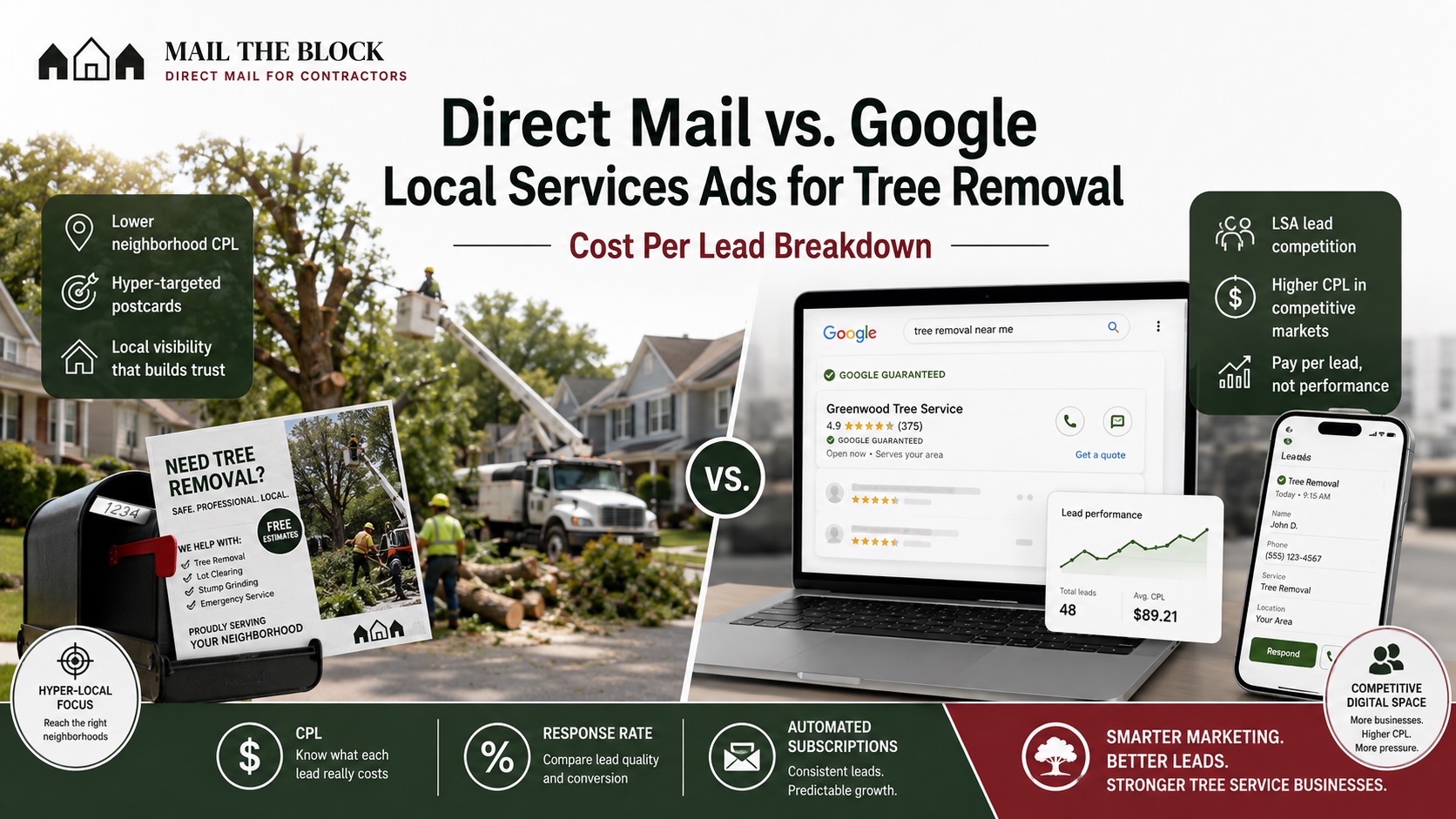
Google Local Services Ads and neighborhood direct mail solve two different tree service marketing problems. Google LSA captures homeowners actively searching for tree removal, while jobsite-based direct mail reaches nearby homeowners who may have already seen the crane, bucket truck, chipper, or crew working on their street. Google charges LSA advertisers for valid leads rather than clicks, and Google confirms that lead pricing varies by location, service type, lead type, bidding strategy, and competition. There is no universal published tree-service CPL. For planning purposes, a tree contractor seeing $50, $100, or $150+ LSA leads can compare those costs against the total cost of sending a tightly targeted postcard campaign to surrounding homes and calculate CPL from actual responses.
At Mail the Block, we prefer treating direct mail as a way to monetize neighborhood attention that already exists around a tree project rather than attempting to replace every digital advertising channel.
Google LSA Is Pay Per Lead, Not Pay Per Click
One important distinction comes first.
Google Local Services Ads are not traditional pay-per-click ads. Tree service companies are charged when qualifying homeowners contact the business through the ad.
Google states that lead prices can vary based on:
- Location
- Job or service type
- Lead type
- Bidding strategy
- Competition
- Business profile quality
Tree services are currently an eligible Local Services Ads category in the United States.
Google also offers Maximize Leads, Target CPL, and Max Per Lead bidding options. That provides useful budget control, but it also means the cost per lead for tree service can change as competitors, demand, and market conditions change.
For official details, see Google Local Services Ads Help.
What Does a $50 to $150 Tree Service Lead Actually Cost?
Consider three illustrative LSA scenarios.
| LSA Cost Per Lead | 10 Leads | 25 Leads | 50 Leads |
|---|---|---|---|
| $50 CPL | $500 | $1,250 | $2,500 |
| $100 CPL | $1,000 | $2,500 | $5,000 |
| $150 CPL | $1,500 | $3,750 | $7,500 |
These numbers are examples, not a Google-published tree service benchmark.
A $100 lead can still be profitable when that lead becomes a $4,000 removal project. The problem appears when several contractors are competing for the same homeowner and only a small percentage of paid leads become booked work.
That makes cost per booked job more important than CPL alone.
Use This Formula
Marketing Spend ÷ Leads = Cost Per Lead
Then calculate:
Marketing Spend ÷ Booked Jobs = Cost Per Acquisition
A campaign generating cheap leads that never close can perform worse than a higher-cost campaign producing profitable removals.
How Jobsite Direct Mail Changes the Targeting Strategy
Search advertising starts with homeowner intent.
Radius direct mail starts with proximity and visible proof.
Tree removal creates unusually strong neighborhood attention. Homeowners can see:
- Crane setups
- Bucket trucks
- Climbing crews
- Chippers
- Logs and debris
- Traffic control
- A major change to the neighboring property
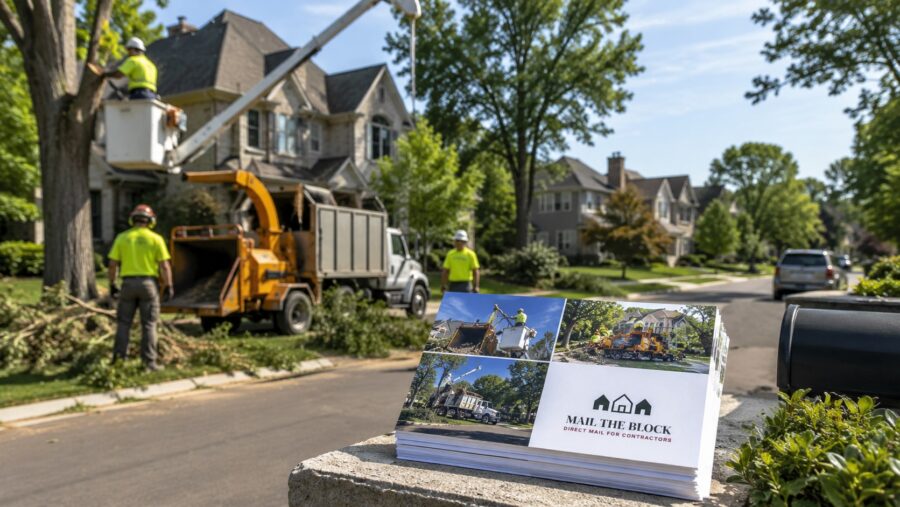
Mail the Block allows tree companies to submit a jobsite address and reach 30 nearby homeowners with a postcard connected to the work already happening on that street.
Explore our Tree Removal Postcards.
Instead of advertising to someone who has never heard of the company, the postcard can say:
Our tree crew recently completed work near your property. Need an estimate while our equipment is already in the area?
That context can make the mailing feel closer to a neighborhood referral than a generic advertisement.
Direct Mail CPL Example
Direct mail CPL depends on the campaign cost and response rate.
Suppose a hypothetical 30-home campaign costs $75 total after design, printing, postage, and targeting.
| Responses | Cost Per Lead |
| 1 lead | $75 |
| 2 leads | $37.50 |
| 3 leads | $25 |
| 4 leads | $18.75 |
That $75 figure is only an example for explaining the calculation, not current Mail the Block pricing.
The advantage is that every recipient lives near an actual tree project. The campaign does not need hundreds of responses to create value.
One additional removal, pruning project, or stump-grinding job can pay for multiple neighborhood campaigns.
Google LSA vs. Radius Direct Mail
| Factor | Google LSA | Jobsite Direct Mail |
| Audience | Active searchers | Nearby homeowners |
| Pricing | Pay per valid lead | Campaign-based |
| Competition | Auction-based | Mailbox competition |
| Intent | Very high | Moderate to high when job is visible |
| Local proof | Reviews/profile | Actual nearby project |
| Geographic precision | Service-area based | Homes around one job |
| Lead costs | Variable | Controlled campaign spend |
| Best use | Capture existing demand | Create demand around active work |
We do not view this as an either-or decision.
The strongest tree removal advertising strategies can use Google to win the first customer and direct mail to turn that customer into a neighborhood cluster.
Turn One $100 Lead Into Several Opportunities
Suppose Google produces a tree removal lead for $100.
The contractor wins the job.
Without neighborhood marketing, that $100 acquisition produces one customer.
Now imagine triggering a postcard campaign around the same property while the crane and crew are still fresh in neighbors’ minds.
That original digital lead now becomes the starting point for a second marketing channel.
The economics change from:
Paid lead → one job
to:
Paid lead → one job → neighborhood campaign → additional estimates
That is one of our favorite tree service marketing ideas because the contractor is building density around work already booked.
More jobs on the same street can also mean less equipment transport, shorter crew travel, and easier scheduling.
Automate the Campaign Instead of Relying on the Crew
The biggest weakness in radius marketing is forgetting to launch it.
Mail the Block is built around active jobsites. Contractors can submit an address through the web, text it from the field, or use CRM-connected workflows, allowing neighborhood postcard campaigns to become a repeatable part of completing a job.
For a deeper comparison of broad route mailing and tighter jobsite targeting, see USPS EDDM vs. Radius Marketing for Contractors.
Lower CPL by Marketing Around Work Already Won
Google LSA can be extremely valuable because it captures homeowners already looking for tree service. The downside is that every tree company in the auction wants that same customer.
Direct mail creates a different opportunity.
At Mail the Block, we help tree service companies turn visible removals, pruning projects, storm cleanup, stump grinding, and crane work into neighborhood campaigns automatically.
Instead of paying repeatedly to reach strangers, use each completed tree project to introduce the company to the homeowners already watching the work.
Ready to make radius mail part of every tree job? Schedule a Mail the Block demo and explore automated direct mail campaigns built around active jobsites.