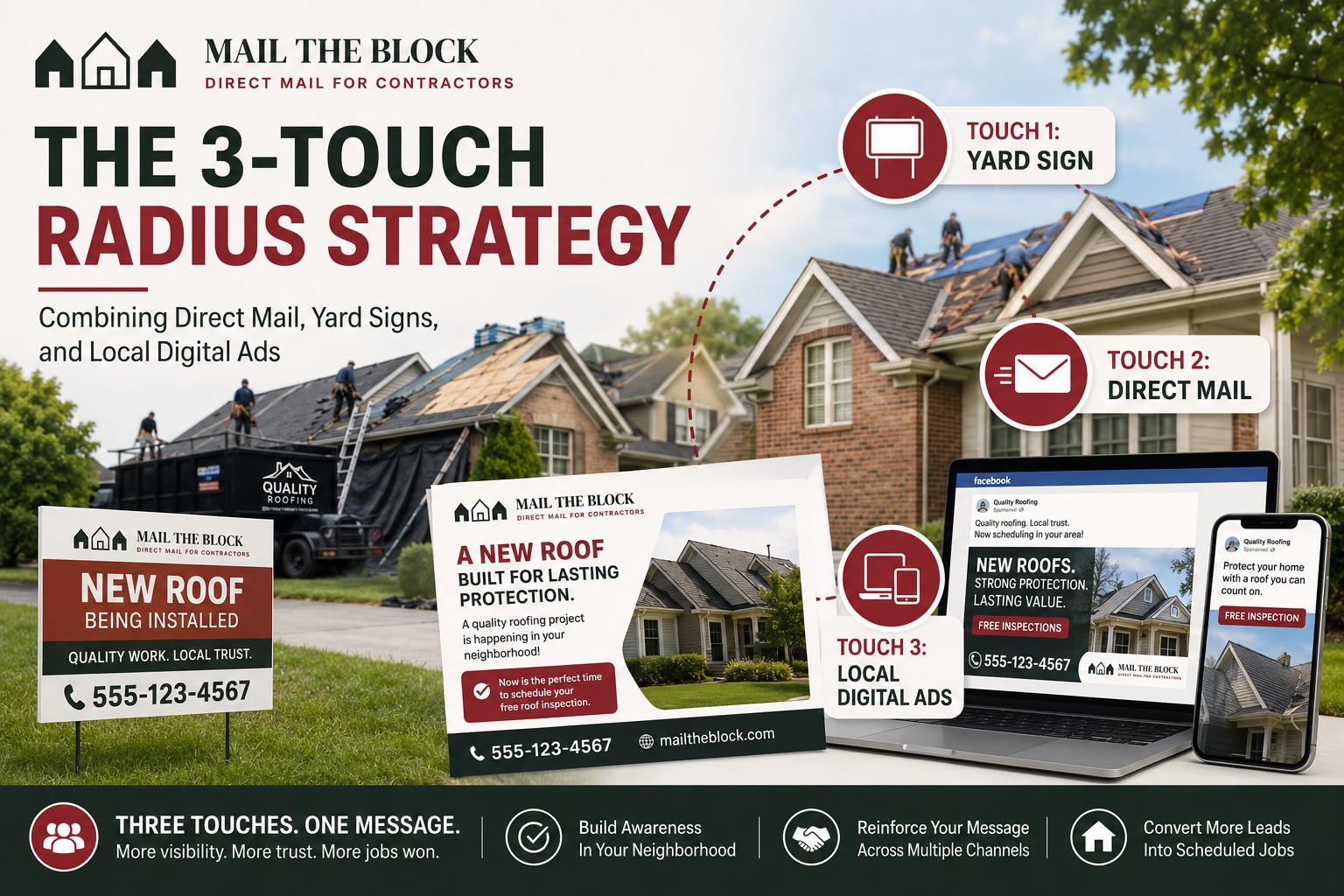
The 3-Touch Radius Strategy turns each active roofing project into a neighborhood marketing campaign. Place a branded yard sign when tear-off begins, send a localized postcard to 30 nearby homeowners after the project, and run digital ads around the same neighborhood. Each channel supports the others. The sign provides visible proof, the postcard explains the offer, and the digital ad reinforces recognition when neighbors search or browse online. USPS research indicates that physical advertising can create stronger memory than digital advertising alone, while its omnichannel guidance supports combining mail with digital channels throughout the customer journey.
A homeowner may ignore an unfamiliar roofing ad. That same homeowner reacts differently after seeing the company truck on Maple Avenue, noticing a professional sign in the neighbor’s lawn, and receiving a postcard that references the nearby project.
At Mail the Block, we call this a neighborhood takeover. Rather than spreading a marketing budget across an entire county, we concentrate multiple brand touches around places where a contractor already has credibility.
Why Three Local Touches Work Better Together
A roofing project naturally attracts attention. Neighbors hear the tear-off, see the material delivery, watch the crew work, and inspect the finished roof. The opportunity disappears when no clear brand connects that activity to a contractor.
The three-touch framework gives each channel a specific job:
| Touch | Timing | Primary Role |
|---|---|---|
| Yard sign | Day 1 of tear-off | Establish visible jobsite proof |
| Direct mail | At completion | Explain the service and provide a response path |
| Local digital ads | During and after the project | Reinforce recognition online |
This sequence creates familiarity without depending on one advertisement to produce an immediate call.
Touch 1: Install the Yard Sign on Day 1
Place the yard sign before or as tear-off begins, subject to homeowner approval. Early placement gives neighbors time to associate the crew, trucks, progress, and finished roof with the company name.
The design should communicate quickly to passing drivers. Include:
- Company logo and roofing service
- Large phone number or short website
- One direct trust message
- High-contrast colors
- A QR code only when it remains easy to scan
Avoid crowding the sign with certifications, multiple offers, and long service lists. A roadside sign has only a few seconds to communicate.
Mail the Block’s signs use weather-resistant Coroplast, double-sided printing, H-stakes, and layouts designed for roadside visibility.
Touch 2: Mail 30 Nearby Homeowners
Trigger the postcard when the roof is complete or nearing completion. The strongest message is not a generic roofing promotion. It is proof that the company already completed work nearby.
A localized headline could read:
A New Roof Was Just Completed on Maple Avenue
The postcard should include a finished-project photo, concise service message, local trust signals, phone number, landing page, and clear call to action. Good offers include a complimentary roof inspection, storm-damage assessment, or replacement consultation.
Mail the Block allows contractors to submit a jobsite address and send a custom-designed postcard to 30 surrounding neighbors. The street can be referenced by name, helping the piece feel connected to a real nearby project rather than a mass advertisement.
Touch 3: Reinforce the Campaign With Local Digital Ads
Use the same project photo, offer, colors, and headline in the digital campaign. A homeowner who remembers the yard sign or postcard should immediately recognize the online ad.
The 300-meter radius works well as a planning concept for defining the immediate neighborhood footprint. However, advertising platforms may not allow a literal 300-meter target. Google Ads currently requires radius targeting of at least one kilometer and may limit delivery when an area does not meet minimum privacy or audience thresholds.
Depending on the platform, use:
- The smallest permitted radius around the jobsite
- ZIP Code or city targeting
- Neighborhood-level audience areas
- A larger radius with location exclusions
- Display, social, video, or search campaigns using matching creative
Set location targeting toward people physically present in the service area when available. Otherwise, ads may reach users who only showed interest in the location without living nearby.
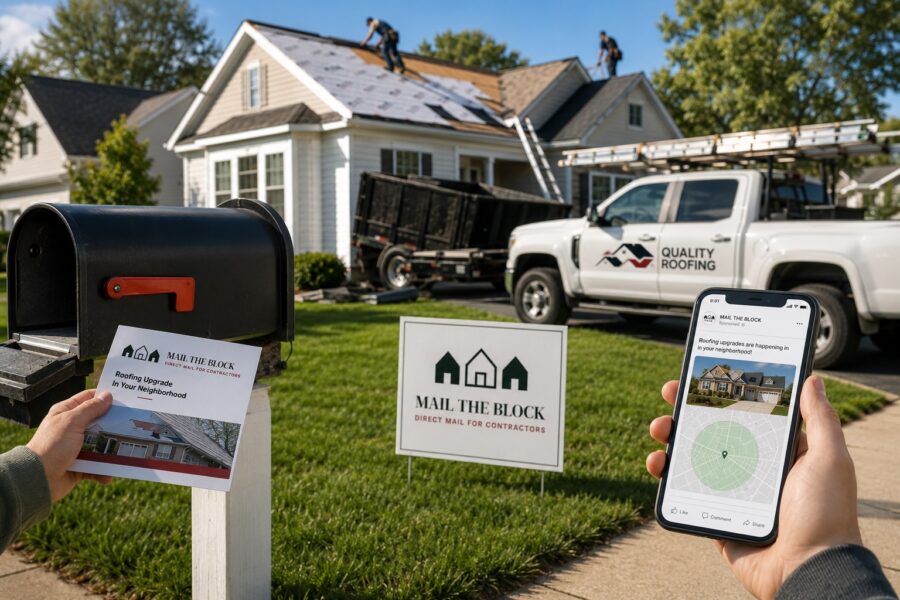
Keep Every Touch Visually Consistent
The campaign loses strength when the sign is black and red, the postcard is blue, and the digital ad uses unrelated photography.
Use the same:
- Logo placement
- Core colors
- Project photograph
- Offer
- Headline theme
- Phone number
- Landing page
Consistency helps homeowners connect separate exposures to the same roofing company.
Track the Entire Neighborhood Campaign
Use one landing page and tracking structure for each project or neighborhood. Measurement options include QR codes, call tracking, campaign-specific forms, and CRM source fields.
Track more than immediate leads. Record:
- Postcards delivered
- Landing-page visits
- Calls and form submissions
- Inspections scheduled
- Estimates issued
- Jobs closed within the radius
- Revenue generated from the neighborhood
USPS recommends tools such as QR codes, personalized URLs, promo codes, and matchback analysis to connect direct mail with digital activity and campaign results.
Build a Repeatable Local Contractor Brand Awareness Playbook
The best roofing direct mail marketing campaign strategy does not treat every job as an isolated project. Each completed roof becomes proof, content, targeting data, and a reason to contact nearby homeowners.
Place the sign on Day 1. Trigger the postcard at completion. Run matching digital creative during the project and for a defined period afterward. When another job closes on the same street, repeat the process and expand the neighborhood footprint.
Mail the Block helps contractors activate the direct-mail and yard-sign portions of this system without adding complicated office work. Our direct mail postcard service turns active jobsites into localized campaigns designed to generate more work on the same street.