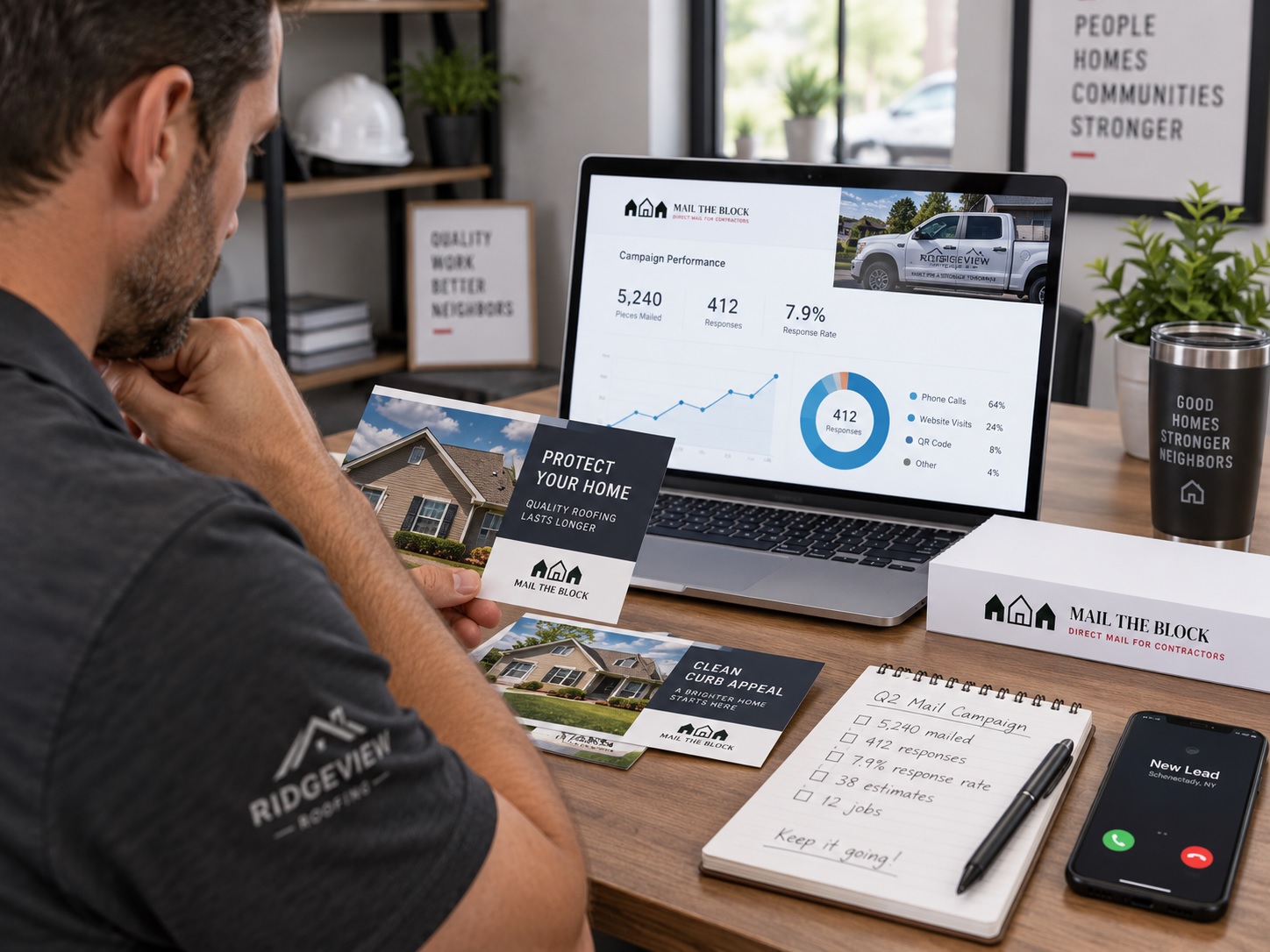
A good direct mail response rate depends on the audience, service, offer, targeting, and average job value. Broad marketing benchmarks provide useful context, but contractors should not judge a campaign by response percentage alone. A 1% campaign can outperform a 5% campaign when those responses become high-value jobs. Track responses, qualified leads, estimates, booked work, cost per lead, acquisition cost, and revenue together.
Contractors often ask us what response rate they should expect from postcards.
The better question is: What does each response turn into?
A roofing, paving, landscaping, painting, tree service, HVAC, or remodeling campaign can generate a relatively small number of responses and still produce excellent returns when one or two responses become profitable jobs.
What Is the Average Direct Mail Response Rate?
The Association of National Advertisers released its latest Response Rate Report in July 2025 to provide benchmark data across marketing channels and audience segments. The report emphasizes comparing results with relevant business and audience types rather than relying on one universal number.
Industry summaries commonly cite overall direct-mail response around 4.4%, with existing-customer or house lists often outperforming cold prospect lists.
That does not mean contractors should expect 4.4% from every postcard campaign.
A past-customer campaign and a cold neighborhood mailing are fundamentally different.
Existing Customers and House Lists
These recipients already have some relationship with the company and may include:
- Past customers
- Maintenance-plan clients
- Previous estimates
- Referral contacts
- Existing commercial accounts
Trust already exists, so response behavior can differ significantly from cold prospecting.
New Prospects
Cold audiences can include EDDM routes, purchased homeowner lists, targeted neighborhoods, or homes surrounding a current jobsite.
These campaigns often depend more heavily on targeting, repetition, trust signals, timing, and local relevance.
What Counts as a Direct Mail Response?
A response is an action generated by the mailing.
That could include:
- Phone calls
- Website forms
- Text messages
- Estimate requests
- Coupon redemptions
- Landing-page conversions
- QR-code activity that leads to an inquiry
One important distinction is that a QR scan by itself is not necessarily a qualified lead.
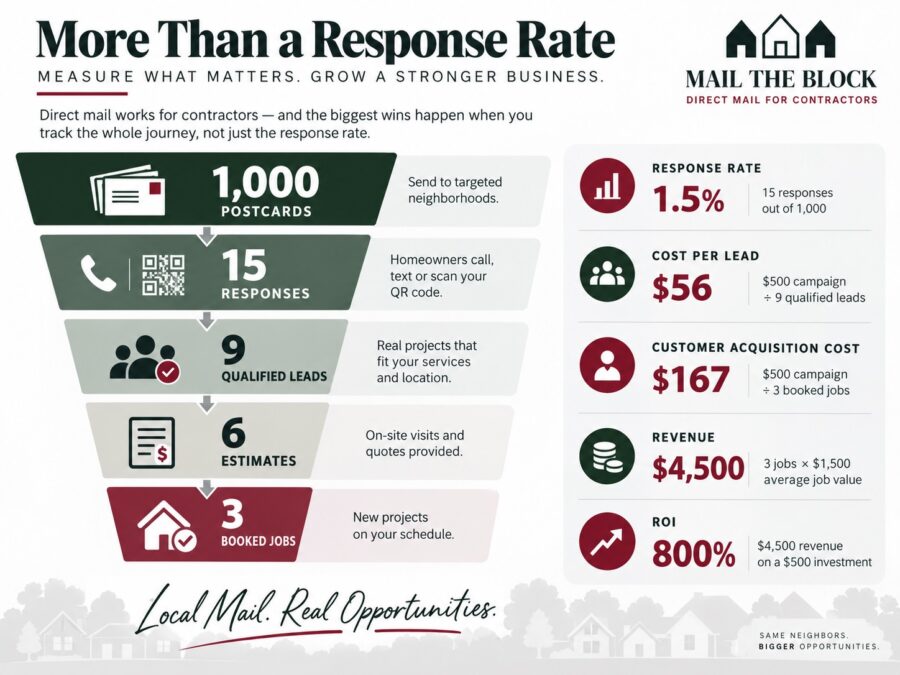
We recommend tracking the funnel as:
Engagement → Response → Qualified Lead → Estimate → Booked Job
That prevents inflated response numbers from hiding weak sales performance.
How Do We Calculate Direct Mail Response Rate?
The formula is straightforward:
Response Rate = Responses ÷ Pieces Mailed × 100
For example:
1,000 postcards mailed
15 tracked responses
15 ÷ 1,000 × 100 = 1.5% response rate
But that 1.5% does not tell us whether the campaign made money.
Those 15 responses could create two booked jobs or ten. The financial outcome would be completely different.
Response Rate vs. Conversion Rate
Contractors should track several stages separately.
| Metric | What It Measures |
|---|---|
| Response rate | People responding to the mailing |
| Lead rate | Responses becoming legitimate opportunities |
| Estimate rate | Leads reaching the quote stage |
| Close rate | Estimates becoming customers |
| Cost per lead | Campaign spend divided by leads |
| Customer acquisition cost | Campaign spend divided by customers |
| Revenue | Sales attributed to the campaign |
| ROI | Financial return relative to campaign cost |
Consider a campaign with:
2,000 postcards → 20 responses → 12 qualified leads → 8 estimates → 3 booked jobs
The response rate is only 1%.
But if those three jobs generate strong margins, the campaign may be far more valuable than another mailing with a higher response percentage and weaker customers.
Is a 1% Direct Mail Response Rate Good?
It can be.
Suppose a roofing contractor mails postcards around a recently completed roof and receives only a handful of responses. If one response produces a $15,000 roof replacement with a healthy margin, the campaign economics could be excellent.
The same applies to paving, tree removal, hardscaping, remodeling, fencing, and other high-ticket services.
Meanwhile, a 5% response rate filled with price shoppers and unqualified inquiries may create far less revenue.
Response rate measures activity. Revenue measures business impact.
How Many Leads Should 1,000 Postcards Generate?
There is no responsible fixed answer.
Results can vary according to:
- Existing versus new customers
- Trade
- Neighborhood
- Property characteristics
- Season
- Project timing
- Offer
- Postcard design
- Reputation
- Call to action
- Campaign repetition
A national average should never become a sales forecast.
For planning, contractors can model conservative, target, and strong scenarios. Over time, those assumptions should be replaced with the contractor’s own campaign history.
Your historical data will eventually become far more useful than a general direct mail benchmark.
Why Contractor Direct Mail Performs Differentl
Home-service marketing has characteristics that broad national benchmarks cannot fully capture.
Contractor campaigns are often:
- Hyperlocal
- High-ticket
- Seasonal
- Neighborhood-specific
- Triggered by visible projects
- Strongly influenced by homeowner timing
Mail the Block is built around this local context. Contractors can submit a jobsite address and send postcards to nearby homes, using the real project as neighborhood credibility.
A message such as “We just completed a project near you” arrives with context that a generic retail postcard does not have.
Our direct mail marketing services support jobsite-radius campaigns, EDDM coverage, and more targeted homeowner approaches depending on the campaign goal.
What Makes a Contractor Postcard Get More Responses?
Better Targeting
Mail homeowners who are more likely to need the service rather than maximizing volume for its own sake.
Local Relevance
Nearby work creates familiarity and social proof. A homeowner may have already seen the truck, crew, roof, driveway, fence, or landscape project.
Real Project Photos
Authentic completed-work photos can create stronger credibility than generic stock imagery.
Clear Headline
The homeowner should understand the service and message within seconds.
One Primary Offer
Avoid trying to advertise every service on one postcard.
Clear Call to Action
Use one obvious next step, such as:
- Call for an estimate
- Request a quote
- Scan to schedule
- Check availability
Trust Signals
Reviews, years in business, warranties, certifications, and local project references can reduce uncertainty.
Why Neighborhood Targeting Can Matter More Than Creative
A beautifully designed postcard mailed to the wrong homeowner is still poor marketing.
Useful targeting variables can include homeownership, property type, house age, lot size, home value, recent jobs, neighborhood density, and seasonal service needs.
For contractors deciding between broad route coverage and tighter targeting, our comparison of EDDM vs. radius marketing explains how each approach serves a different campaign goal.
Does Mailing More Than Once Help?
One mailing does not always tell the full story.
A homeowner may ignore the first postcard, recognize the company after the second, and need the service when a later piece arrives.
Repetition creates additional opportunities to be remembered when demand appears.
That does not mean every campaign should simply be repeated unchanged. Route performance, message, offer, timing, and lead quality should guide the next mailing.
What Metrics Matter More Than Response Rate?
Response rate belongs on the dashboard, but it should not sit alone.
For contractor campaigns, we focus on:
Qualified leads + estimates + booked jobs + cost per lead + customer acquisition cost + revenue + ROI
That tells us whether the campaign produced actual business.
At Mail the Block, the goal is not to chase the highest possible response percentage. The goal is to help contractors turn nearby homeowners into profitable jobs while creating denser routes and more work in neighborhoods where crews are already operating.
Frequently Asked Questions
What is a good direct mail response rate?
There is no universal percentage. Audience quality, service type, offer, targeting, job value, and campaign type all affect performance.
Is a 1% direct mail response rate good?
It can be. A 1% campaign that produces profitable high-ticket jobs may outperform a campaign with a much higher response rate but weak lead quality.
How do we calculate direct mail response rate?
Divide tracked responses by the number of pieces mailed, then multiply by 100.
How many leads should 1,000 postcards generate?
There is no guaranteed number. Contractor, audience, neighborhood, season, targeting, offer, and reputation can all change results.
Should QR-code scans count as responses?
A scan shows engagement, but it should not automatically be counted as a qualified lead. Track scans separately from inquiries, estimates, and booked jobs.