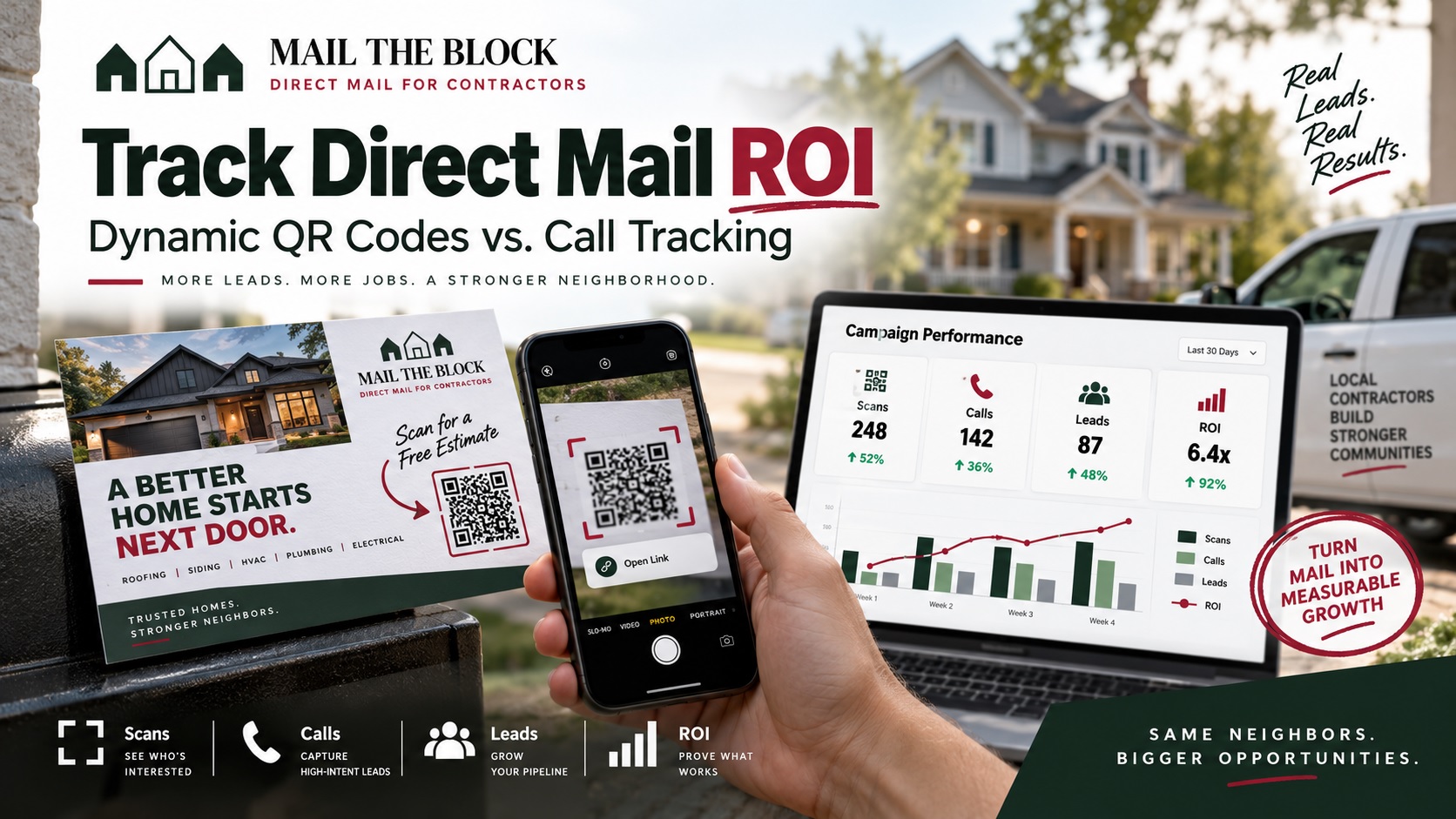
The most reliable way to measure direct mail ROI is to give every campaign a trackable response path. At Mail the Block, we recommend combining a dedicated call tracking number with a dynamic QR code linked to a campaign-specific landing page. Call tracking captures homeowners who prefer to speak with a contractor, while QR tracking measures scans, landing-page visits, form submissions, and other digital actions. USPS also recommends campaign-specific phone numbers, QR codes, and personalized URLs as direct-mail attribution tools.
The goal is not simply counting postcard responses. We want to know which mailings create qualified leads, booked estimates, sold jobs, revenue, and profit.
Why Direct Mail Tracking Matters for Contractors
A contractor may send 1,000 postcards and receive several calls, but without attribution there is no reliable way to know whether those leads came from the mailer, Google, a referral, or an old customer.
Our direct mail marketing services can incorporate QR codes, call tracking, landing pages, offer codes, and campaign analytics so contractors can compare neighborhoods, offers, and services rather than guessing which campaign worked. Mail the Block specifically supports optional QR tracking and call tracking as part of its campaign workflow.
Call Tracking for Direct Mail
Call tracking for direct mail uses a phone number assigned specifically to one campaign or mailing group.
When a homeowner calls that number, the system can attribute the response to the postcard campaign.
Depending on the platform, contractors may track:
- Calls generated
- Call duration
- Date and time
- Answered vs. missed calls
- Qualified leads
- Booked appointments
- Source campaign
This works especially well for urgent home services.
A homeowner with a leaking pipe, storm-damaged roof, dead tree, or failed HVAC system may call immediately rather than scan a QR code and browse a website.
Best Uses for Call Tracking
We favor call tracking for:
- Plumbing
- HVAC
- Roofing
- Electrical
- Tree removal
- Emergency restoration
- Well and septic service
Use a different tracking number for each campaign when possible. Otherwise, several mailings can become mixed into one attribution bucket.
Direct Mail Tracking With Dynamic QR Codes
A direct mail tracking QR code connects the physical postcard to a measurable digital experience.
Dynamic QR codes are especially useful because the printed code points through a managed redirect. That means the landing-page destination can often be updated after printing without changing the QR artwork.
A campaign can track:
- Total scans
- Scan dates and times
- Repeat scans
- Device type
- Landing-page sessions
- Quote-form submissions
- Online bookings
USPS notes that QR codes and personalized URLs can help marketers measure engagement and connect direct mail to online behavior.
Best Uses for QR Codes
We particularly like QR tracking for visually driven, higher-consideration services such as:
- Landscaping
- Hardscaping
- Painting
- Remodeling
- Paving
- Siding
- Outdoor living
- Cabinet refinishing
Instead of asking homeowners to type a long website address, the postcard can send them directly to project photos, an estimate form, financing information, or a service-specific landing page.
QR Code vs. Call Tracking
| Metric | Dynamic QR Code | Call Tracking |
|---|---|---|
| Measures initial response | Yes | Yes |
| Tracks website behavior | Excellent | Limited |
| Captures phone-first leads | No | Excellent |
| Supports online forms | Excellent | No |
| Good for emergency services | Moderate | Excellent |
| Good for visual projects | Excellent | Good |
| Campaign attribution | Strong | Strong |
For most contractors, we recommend using both.
One homeowner wants to call. Another wants to browse completed projects before speaking with anyone. The postcard should make both behaviors measurable.
How to Measure Direct Mail ROI
Do not stop at response rate.
Track the entire funnel.
Response Rate
Responses ÷ Mail Pieces Sent × 100
If 1,000 postcards generate 20 tracked responses:
20 ÷ 1,000 = 2% response rate
Cost Per Lead
Campaign Cost ÷ Qualified Leads = CPL
A $1,200 campaign producing 15 qualified leads generates:
$1,200 ÷ 15 = $80 CPL
Cost Per Booked Job
If those 15 leads generate five jobs:
$1,200 ÷ 5 = $240 acquisition cost
This is often more important than CPL.
Our related tree service cost-per-lead comparison explains why a cheap lead that never closes can perform worse than a more expensive lead that becomes profitable work.
Marketing ROI
A useful profitability calculation is:
(Gross Profit From Campaign Jobs – Campaign Cost) ÷ Campaign Cost × 100
If mailed jobs create $6,000 in gross profit from a $1,500 campaign:
($6,000 – $1,500) ÷ $1,500 = 300% ROI
What Is an Acceptable Cost Per Lead?
There is no universal direct-mail CPL for home services.
Trade, job value, geography, season, close rate, and targeting change the answer dramatically.
For context, 2025 LocaliQ search-ad benchmarks reported average CPLs of approximately:
| Trade | Search Advertising CPL |
|---|---|
| Roofing & Gutters | $228 |
| Painting | $138 |
| Plumbing | $129 |
| HVAC | $128 to $129 |
| Landscaping | $118 |
| Electrical | $94 |
These are paid-search benchmarks, not direct-mail benchmarks, but they provide useful competitive context.
We prefer establishing an allowable CPL from job economics.
If a contractor can profitably spend $400 to acquire a customer and closes 25% of qualified leads, the allowable CPL is:
$400 × 25% = $100 per lead
A $70 CPL would then be healthy. A $150 CPL may require a higher close rate, larger average job, or stronger lifetime value.
Track Every Mailing Like a Digital Campaign
At Mail the Block, we want contractors to know more than how many postcards were mailed.
The better dashboard shows:
postcards sent → scans → calls → qualified leads → estimates → booked jobs → revenue → gross profit
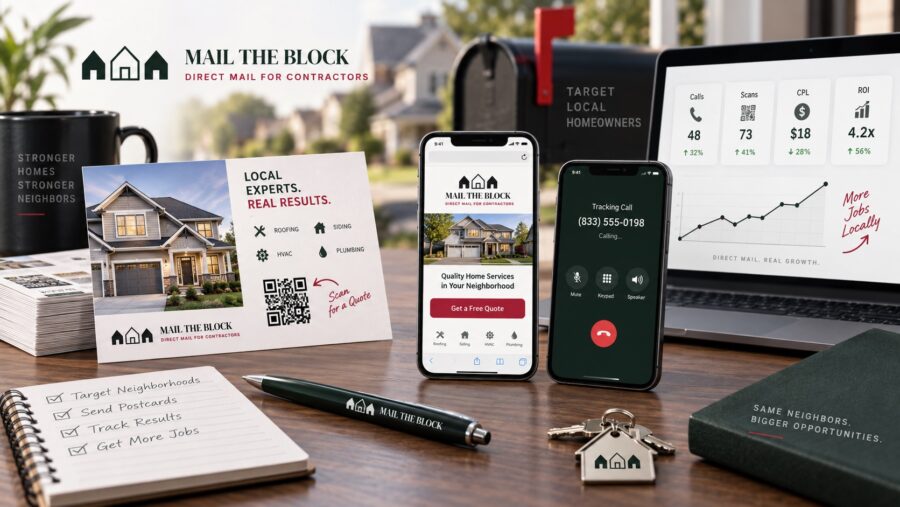
Dynamic QR codes show what happens online. Call tracking captures phone-first homeowners. CRM attribution closes the loop by showing which responses become paying customers.
That turns direct mail from an unmeasured advertising expense into a repeatable acquisition channel that can be optimized neighborhood by neighborhood.